
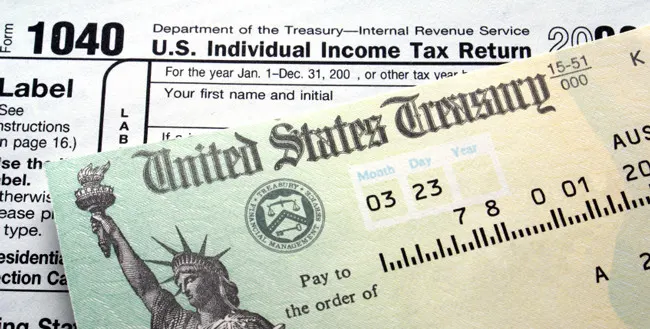
In previous posts, I’ve written at length about several alternatives to the overbearing tax code that exists in the United States today. While there are several directions the nation could go to fund government functions, one thing is certain…the income tax must go. I say this not only for economic reasons, but for philosophical and moral reasons as well.
Let me begin by saying this plainly. Income tax is theft. It is based on the premise that government has a higher claim on your property than you, the true owner. Not only does it assume government has the right to take what it wants, it has no obligation to render a service in exchange, and quite often the tax money is transferred to another party. In short, if you or I did what the government does, we would be guilty of theft.
Until the 20th century, most revenue collected by the federal government was in the form of tariffs and duty fees. This type of taxation could be thought of as user fees for services rendered, or at the very least, the cost of doing business. In other words, if you wanted to import/export goods through the ports, you would have to pay to use the ports.
A tariff and user fee tax system is much like a market, where and individual or business is paying for services rendered by the government. In many local governments, property taxes are used to pay for services like police, fire and schools. These services benefit everyone in a community, so it could be argued that taxing property is the easiest way for everyone in the region to pay for the services rendered by the government. Another example is the gas tax; it his how both the state and federal governments pay for the maintenance of roads and bridges (of course, since a gas tax is collect, it begs the question why Democrats are always asking for additional revenue for roads and infrastructure).
Income taxes are vastly different. This is not an exchange of money for service; it is the taking of income by force, with the payer not necessarily getting anything in return. There is also no choice in the matter of taxation. With tariffs, it is the cost of doing business. In the case of a gas tax, one doesn’t have to drive (they can walk or bike). If a person doesn’t like the high property tax rates of a particular region, they can vote with their feet and move to an area with low or no property tax.
With an income tax, there is no voluntary exchange, nor a chance to vote with your feet. You may not observe a benefit from the taxes paid, nor is it likely you will have any choice in how the tax revenue will be spent. Some may argue that since Congress controls spending and they are elected officials, so indirectly we decide how the tax money is to be spent. But that is still a violation of individual rights, as I will illustrate in the following example.
You’re walking through the park with your friends John and Chuck. The three of you encounter another friend, George, who tells you about his financial trouble. You pull out your wallet and give him $20; John does the same. Chuck does not. John gets angry at Chuck, tells him it’s his duty to help those in need. Chuck refuses. John gets more angry, and begins to tell passersby that George needs help, and Chuck is greedy for not helping. Others agree. So many agree, that they get together with their elected representatives, who pass a law forcing Chuck to pay money to the government , who then hand over the money (minus a modest fee) to George.
While the above scenario is the gist of what has happened in this nation since the advent of the income tax, it should be noted that welfare and charity are not where all of this wealth is distributed. Often it is a specific cause, group or industry. We’ve all heard the stories about strange and bizarre research funded by government grants.
In the case of research grants, even if the work benefits society, the question must be raised why taxes should fund the work. If an individual believes a particular project is worthy of funding, then that person may donate to that endeavor. With the success of crowd funding in the past few years, it is easy to make the case that a worthwhile project (and even some not so worthwhile) can easily be funded through donations.
The same can be said of helping the less fortunate through charities. Not only do charities allow individuals to decide what they can and can’t afford to donate, but a person can decide if a charity is worthy of a donation. Donors can also research a charity to see if it is worth giving to, or meets the individual’s moral/ethical code. (On a personal note, I’ve been a fan of Habitat for Humanity for many years. This is a charity that helps people who want to help themselves, a concept that gets two thumbs up from me.) In the case of government welfare programs, we are simply stuck with what the government has created, no matter how corrupt or ineffective they are.
A system of tariffs and users fees naturally demands more accountability on the part of the government. The gas tax provides an example of this. In some regions, gas pumps are marked with the exact amount of state and federal tax added to each gallon of gas. When people realize the government is making more on a gallon than the oil company, citizens want to know where that money is going.
This nation can fund government without an income tax, but not at current spending levels. Of course, the elimination of wealth redistribution eliminates a large chunk of that government spending (and I lump handouts to industry and academia, as well as social services, into that group). And without an income tax, we have no need for an IRS…at least not as we know it today. With a budget of nearly $12 billion and an estimated $4 billion in tax fraud, that’s a sizable savings to the American people. And there are plenty of other places we can save…trust me.
Unfortunately, I don’t see the income tax going away any time soon. As much as I and most liberty minded folk see income tax as an abomination, the truth is that both Republican and Democrat leadership is beholden to big government, and such a large government needs the income tax to fund its bloat. But as citizens it is our right to push for the government we want. For myself and many other, that means a government that doesn’t steal from its citizens.
I hope you’ve enjoyed this post. Please feel free to share the post with friends, and leave comments below. If you’d like to be notified of when new articles are posted, be sure to sign up for our mailing list.

